By Lilly Thies ’26
When you think of the modern artist’s studio, an image may come to mind. Walls filled with art, probably a few different seating options– some chairs, some poufs, maybe even a swing. A drawing desk. Maybe some tools for mixed-media or textile art. Instruments. Paint splatters. As it turns out, the artists’ studio in the Progressive era wasn’t too different– a personalized treasure trove filled with items that inspire creativity. And, same as now, artists back in the day would carve out their own little corners where they could be creative, no matter how inconvenient the physical space. The desire for a personal space to create art was very much alive, and especially for female artists– bringing to mind Virginia Woolf’s idea of a “room of her own”.
Myra Albert Wiggins (1869-1956) was an artist who spent her life between the Pacific Northwest, where she was born and where she raised her family, and New York City, where she went to school at the Art Students League of New York. Her parents encouraged her artistic capabilities both because they recognized her natural talent and because a cultural prowess in the arts was expected of upper-class progressive women at the time. Many of her personal belongings and art are stored in the Pacific Northwest Artists’ Archive in the Willamette University Archives. Although she is mostly known for her oil paintings, which won her a series of awards, her photographs display the quieter, more intimate moments of her life and offer a glimpse into the studio of a Progressive-era artist.
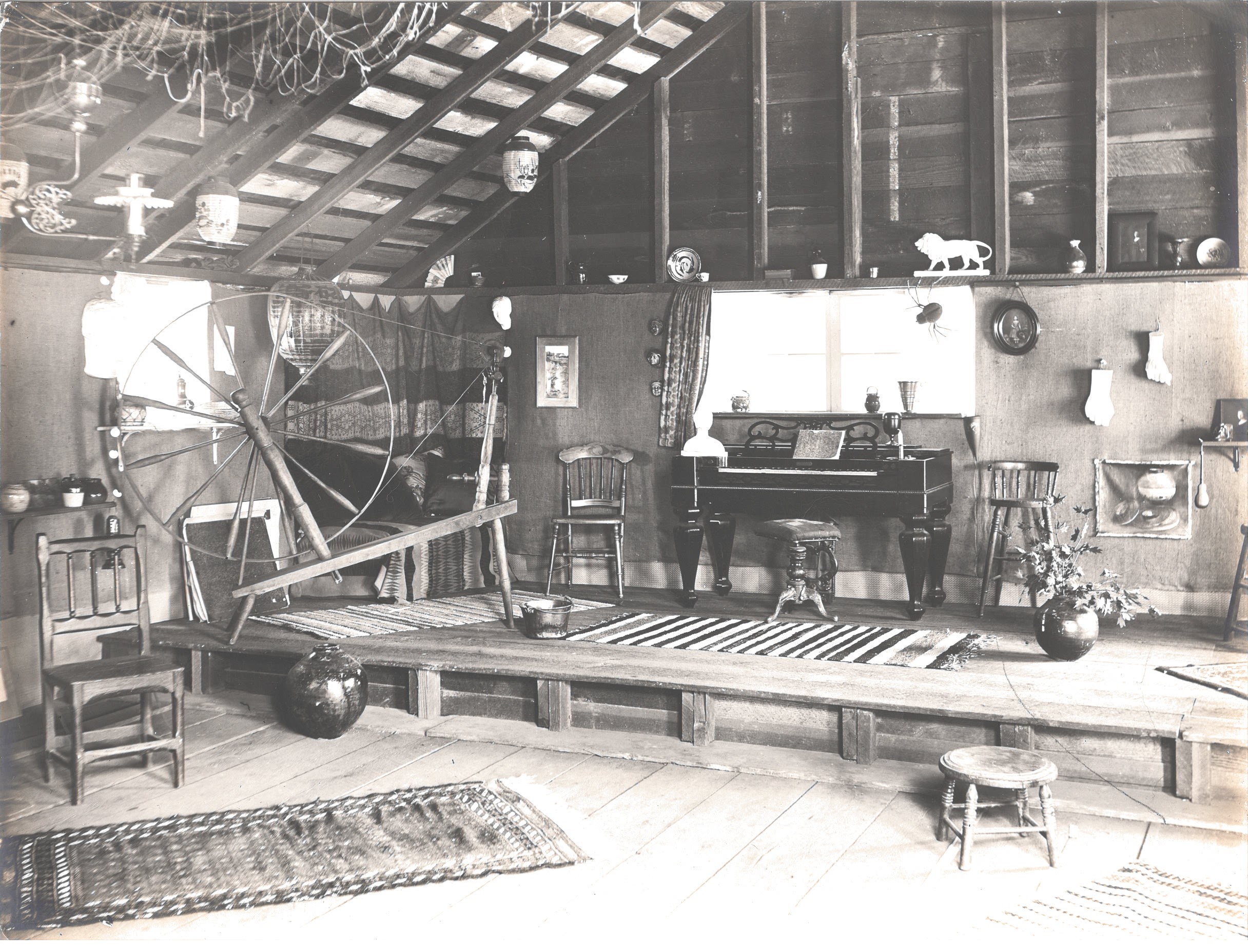
Wiggins’ Salem Studio. Pictured are the piano, center, and spinning wheel, to the left. (Box 9, Folder 4)
Some of Wiggins’ earliest photographs stored in the Archives show her studio in Salem, which she used from the 1890s through the 1920s. The studio was said to be a barn on the backside of the Wiggins family property on Winter street, near where Salem Hospital is now. The barn looks a bit ramshackle from the outside, but the inside is truly remarkable. The space is light and airy, with sun-faded rugs on the floor that brighten up the space. There is an incredible amount of art everywhere– recreations of Greek nude statues, ceramic pots tucked in among the rafters, paintings and photographs and spindly wooden furniture. One gets the sense just looking at the photographs that this place was used constantly and was well-loved by Wiggins, a safe place for her to separate her life as a mother and homemaker from her life as an artist. Not only does she have an impressive collection of visual art, but one corner of the studio features a piano and a spinning wheel. Though Wiggins was primarily a painter and a photographer, perhaps inspiration would have sometimes come to her in the form of a short melody or a textured fabric. Or perhaps these items were heirlooms, furniture meant to inspire creativity in the same way as the paintings and artifacts that covered the walls. Either way, it is clear that Wiggins decorated her space with her art in mind. She had sources of inspiration everywhere she looked, and she gave herself freedom to experiment with whatever medium her creativity demanded.

Wiggins’ improvised studio in Toppenish. Her daughter Mildred is pictured, left. (Box 9, Folder 5)
The next studio Wiggins inhabited was behind her second family home in Toppenish, Washington, where she moved with her family after her husband Frederick began a new business venture. The photograph is entitled “My Improvised Photo Studio in our Alley, Toppenish, 1929”. Improvised is a good word for it; the structure is nearly falling apart, open to the elements, naught but a few pieces of fabric draped across a few pieces of wood. But Wiggins clearly was determined to have her creative space– her “room of her own”– and we can see in the photograph a stool that was present in pictures of her Salem studio, as well as a copper pitcher and a striped rug. Her daughter Mildred appears in the picture, wearing a Dutch headscarf, which Wiggins asserts to be a family heirloom. Even though this photo may just have been intended to document the changes in her life, Wiggins’ creative eye seems to be omnipresent. Her studio space was a crucial part of her process, and even the most run-down structures could harbor her creativity and give her the space she needed to thrive.
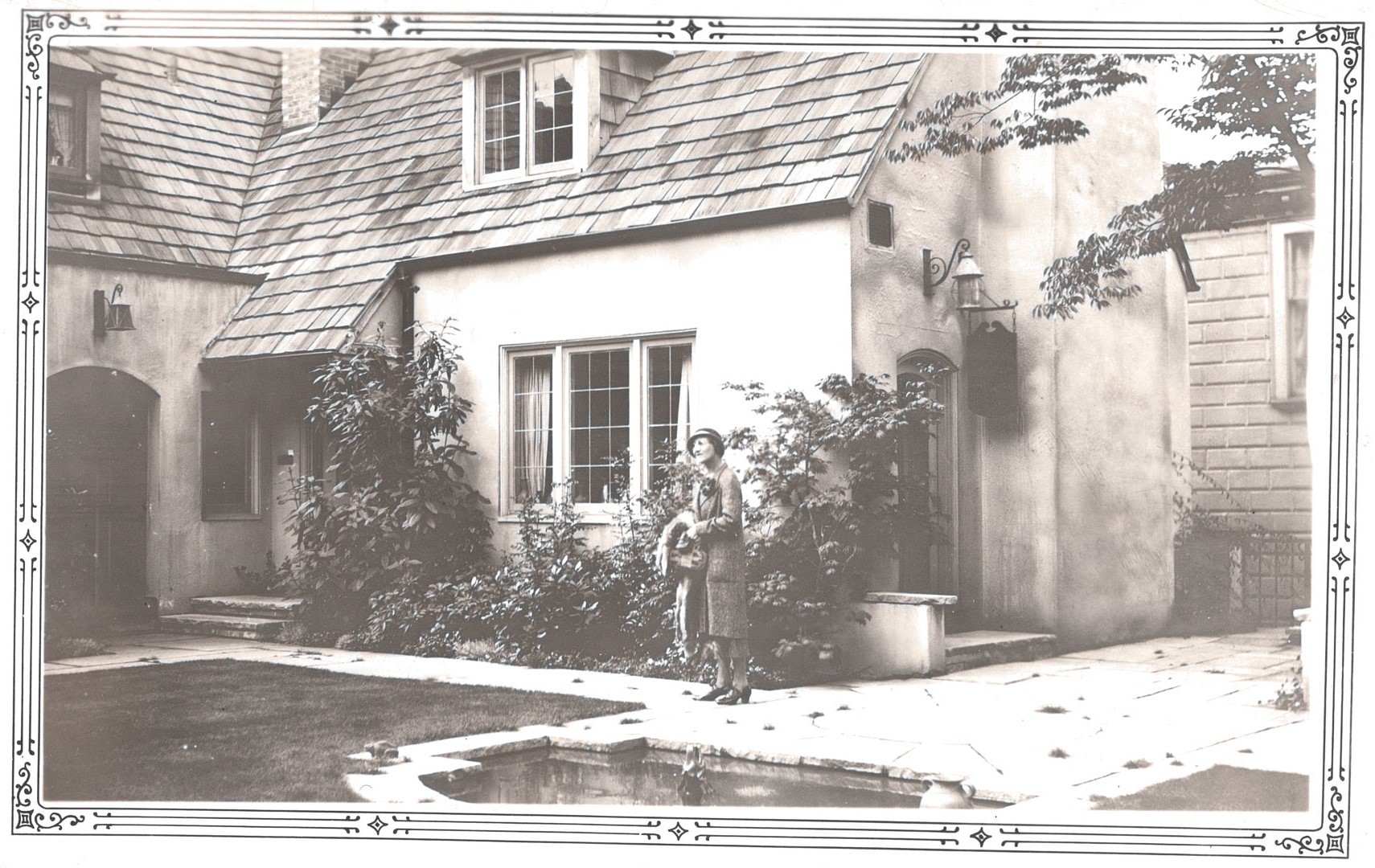
The exterior of Wiggins’ Seattle studio space at Lovelace. (Box 9, Folder 6)
The final glimpse into Myra’s studio space in her later life is a photo taken in Seattle, Washington, where she and her husband moved in 1932 and lived out the rest of their lives. The image shows the Lovelace studio building in downtown Seattle. It is, by far, the most lavish studio space we have seen in Wiggins’ photographs so far, with well-maintained topiary and even a fountain. The image also features Wiggins standing in front of the building, looking very pleased. At this point in her life, she had received a good amount of notoriety for her paintings and photographs, and must have been very proud that she could afford a studio of such high quality without the help of her family or husband. There are no photographs in the collection of the interior Wiggins’ studio space, but past evidence of her decoration indicates that there would have likely been the same bohemian inspirations and heirloom furniture as there had been in the past.
Throughout Wiggins’ photographs, we can see somewhat of an evolution as she faces both life and career changes. From a barn behind her house in Salem, to a shack in Toppenish, to a lavish private studio space in Seattle, Wiggins maintained her creative spirit and sources of inspiration, allowing the art of others and different mediums to help her create her own art. Although she may have not always had the ideal studio environment, she was able to create a space in which she could surround herself with art and nurture her creativity. 100 years ago seems like forever, but the lives of artists back then were more similar to our modern reality than some would think, where creating art was a priority which overcame all the transition periods of life, and where, for women like Myra Wiggins, the studio could be a space that was really, truly theirs.
The Myra Albert Wiggins Papers collection is housed within the Willamette University Archives & Special Collections, providing an invaluable research resource. A portion of this collection has been digitized, offering convenient online access to diaries and notes related to Wiggins’ Color Talks. For more information, please contact the Archives at https://library.willamette.edu/archives.






 Warmer weather, longer hours of daylight, beautiful flowering plants and leafing out trees—it’s the perfect time of year to get outside and go for a walk. And if you need a little additional incentive, May is National Walking Month! Walking is a great form of exercise for most people—you don’t need any equipment beyond decent shoes, you don’t need to be a part of a team to participate, and you don’t need to be athletically gifted. It’s just so easy—you just put on your shoes and walk out the door!
 If you are a student and have written and researched an excellent paper, consider submitting your paper for consideration for the Excellence in Research Award. Faculty, please encourage your best student writers/researchers to apply.

 Although we may not want to admit it, a whole lot of us spend a fair amount of time watching silly cat videos or sitcoms. We love the bloopers at the end of movies or we pretend we’re reading the newspaper for the news but we’re really looking at the cartoons. Well, that’s okay because it turns out that laughter is a wonderful stress relief! According to staff at the Mayo Clinic, laughter has lots of short-term benefits (soothes tension, stimulates heart, lungs, and muscles, etc.) as well as long-term benefits (improves immune system, relieves pain, helps lessen depression, etc.). And now is the perfect time to smile, giggle, and laugh out loud because April is National Humor Month! With the end of the semester looming, all of us could probably benefit from a good laugh so check out the humor-related books on our
  March is National Reading Month and thus an excellent time to celebrate the joys and wonders of reading. Reading is a fundamental skill that enriches us in countless ways; for some of us, reading a great book is like welcoming a new friend into our lives. The freedom to choose what you want to read is exciting and empowering and yet this freedom is being challenged at school and public libraries across the country in record numbers. We all have things we have to read for work and/or school and those documents are important, instructive, and even life changing. But there is something about choosing your own books that harkens back to our early days as a kid standing in front of the children’s section in our local library and reaching for that title that somehow spoke to us saying “Read me!” So exercise your right to read whatever you want by picking up a book of your choice and reading a few minutes each day. To start you out, have a look at the bookish suggestions on our