By Olivia Jacobsen, Class of 2028
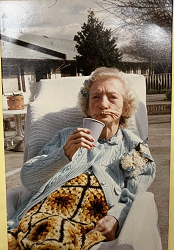
It’s commonly understood that there’s no correct response to death, no correct way to grieve. After experiencing great loss, people behave in a vast array of sometimes peculiar ways. As Joan Didion wrote in her 2005 memoir The Year of Magical Thinking, “The power of grief to derange the mind has in fact been exhaustively noted.” That said, most people wouldn’t hike to the Mount Everest base camp for the first time, at the age of 68, almost directly after the death of their husband. Then again, Kathleen Gemberling-Adkison was not like most people.
Born Kathleen Parks in Beatrice, Nebraska, in 1917, Katahleen would go on to become a well-known Pacific Northwest landscape painter. During the Great Depression, the Parks family moved to Seattle, Washington, where, in Kathleen’s final year of high school, she first received formal art instruction. But it wasn’t until she was mentored by renowned abstract expressionist, Mark Tobey, that she began to develop her distinct style. In a time when female artists were discouraged from painting anything other than portraits and genre paintings, Tobey’s instruction was highly subversive, as he never gave assignments and always encouraged his students to paint what they found interesting. “Before that class, I felt guilty for painting,” Gemberling-Adkison remembered, “I’d been punished in school for drawing, and made to feel that it was something I should try to ‘get over.’ He [Tobey] made me realize that painting was of some worth.”
In 1950, Kathleen moved to Spokane, Washington, where, removed from Tobey’s guidance, she spent time acquainting herself with the area’s natural landscape, later explaining that she enjoyed painting natural landscapes because she liked exploring the mysterious and unexamined places in nature and hoped for her paintings to be “something a person could meditate on” and for them to have elements “that couldn’t be seen at the first viewing.” It wasn’t ever just about the landscape, however. She viewed her landscape work as a metaphor for the layered complexities of human relationships more broadly, stating that “The closer you look, the richer people seem.”
Gemberling-Adkison was married three times. Not much is known about her early marriages aside from the understanding that, if given an ultimatum, Kathleen would invariably choose being a painter over being with a man. In an interview, she stated: “After my first marriage broke up, a psychiatrist told me if I’d just quit painting, my marriage would be OK. I never went back to him.”
Naturally, Kathleen wanted a spouse who would encourage her desire to create, not repress it, and, in 1968, she married Tom Adkison, a prominent Spokane-area architect. She and Tom would go on to travel the world together, visiting Europe and Asia, oftentimes hiking extensively and giving Kathleen inspiration for her paintings. Tom’s companionship indicates his support of Kathleen’s artistic endeavors, but it went further than travel and spending time in nature together, as he participated in shaping the work itself. In a 1978 interview, for instance, Kathleen gave Tom credit for naming all of her pieces. “I like titles, but I don’t name them and can’t think of any titles,” she said. “My husband thinks of all the titles.”
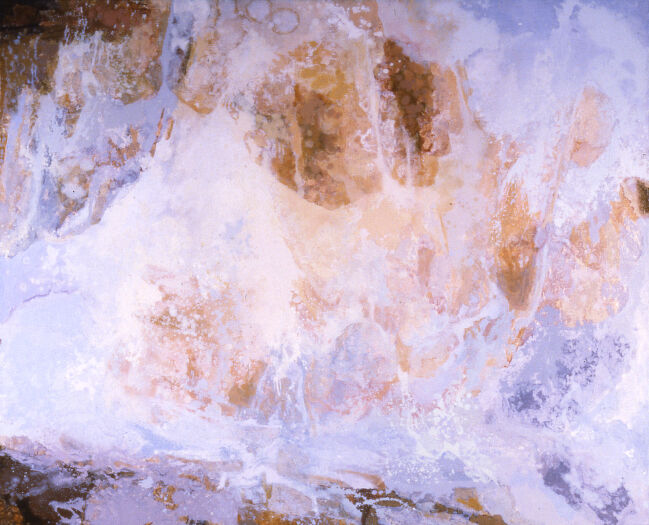
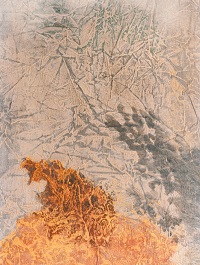
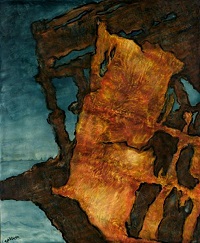
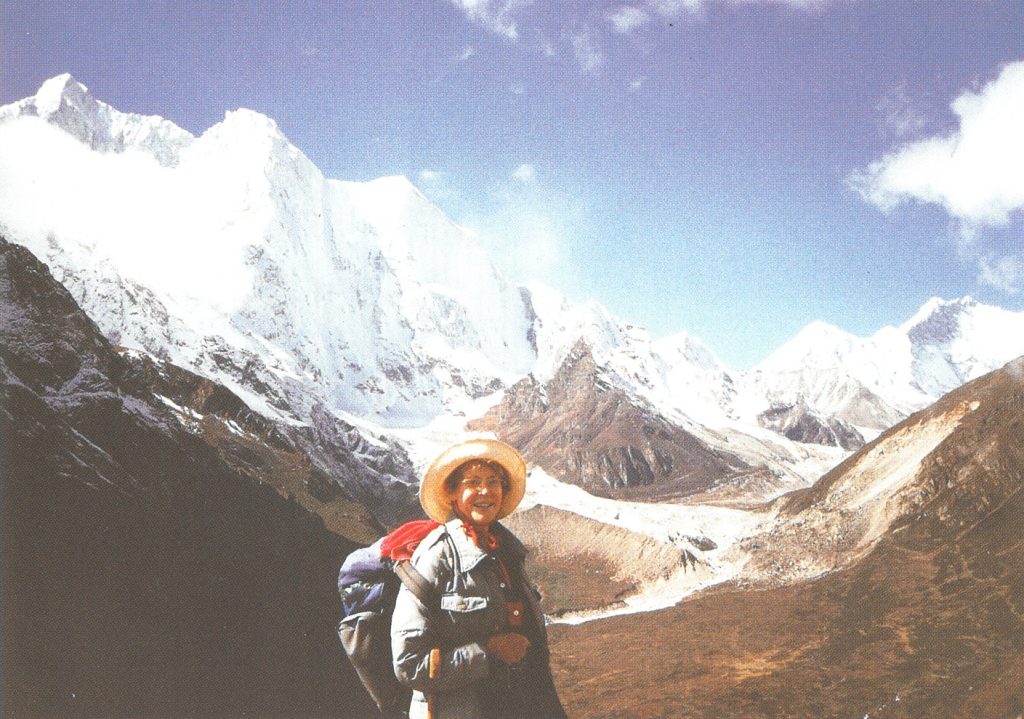
It is impossible to know what emotions Gemberling-Adkison was experiencing when Tom died in March of 1986, but, shortly after his death, she hiked to the base camp at Mount Everest with her friend Jean Kendall. After so many hikes in other countries with Tom, it’s difficult not to see this hike as a way of feeling connected to him after his death. Indeed, in April of 1986, Kathleen painted Everest. It’s difficult to conceptualize the vastness of the world’s tallest mountain, just as it’s impossible to fathom the death of a spouse, and Gemberling-Adkison captures this struggle in Everest. As with any colossal form encountered at close range, the painting has no distinct lines or shapes, emphasizing above all the inability to see, let alone understand, something so tremendous.
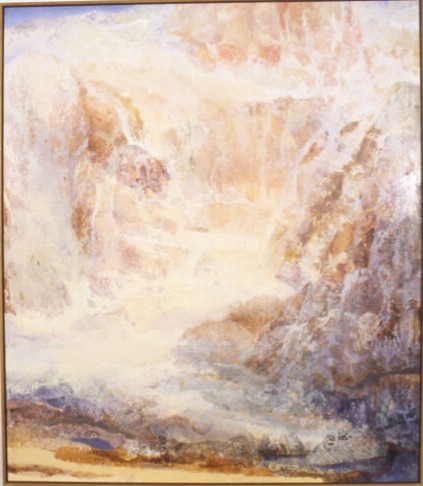
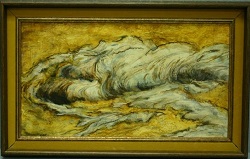
This inability to capture and decipher the whole picture can also be found in the undated work Base Camp. Depicting the conditions at Everest, the bright white colors work in tandem with warmer light pinks and yellows to create a very airy feeling, but it’s more than that. It’s an image that captures the camp’s beauty, but also a feeling of transcendence in the literal sense—not just of being at very high altitude, but of being enveloped in a cloud-like, heavenly state. This is a feeling, perhaps, that follows accomplishing a great feat in the face of hardship. Nor would Kathleen be willing to let that feeling go. Indeed, in 1993, at the age of 76, she completed the hike for the second time, again with her friend Kendall, proving once more that she was nothing if not stoutly determined to defy any and all conventions in her art, in her marriages, and in her grief.
Sources:
Didion, Joan. The Year of Magical Thinking. New York, Alfred A. Knopf, 2005. p.134 Newspaper clippings, 1980-1989, Series I, Box 1, Folder: 4. The Kathleen Gemberling Adkison
papers, WUA053. Willamette University Archives and Special collections.
Newspaper clippings, 1990-1999, Series I, Box 1, Folder: 5. The Kathleen Gemberling Adkison papers, WUA053. Willamette University Archives and Special collections.
Newspaper clippings, undated, Series I, Box 1, Folder: 6. The Kathleen Gemberling Adkison papers, WUA053. Willamette University Archives and Special collections.
Adkison interview, 1978 October 6, Series I, Box 1, Folder: 9. The Kathleen Gemberling Adkison papers, WUA053. Willamette University Archives and Special collections.
Adkison, Kathleen Gemberling. Adkison at Everest Base Camp. Photograph. Exhibitions, 1970
1999, Series I, Box 1, Folder 8. Kathleen Gemberling Adkison Papers (WUA053). Willamette University Archives and Special Collections.
Kathleen Gemberling Adkison Artworks, 1917-2010, OWS_WUA053_Adkison_art, https://digitalcollections.willamette.edu/collections/a4228fc3-ccaa-4132-b06f-28117b369 005