
Climbing One Mountain After Another: The Story of Kathleen Gemberling-Adkison

By Olivia Jacobsen, Class of 2028

It’s commonly understood that there’s no correct response to death, no correct way to grieve. After experiencing great loss, people behave in a vast array of sometimes peculiar ways. As Joan Didion wrote in her 2005 memoir The Year of Magical Thinking, “The power of grief to derange the mind has in fact been exhaustively noted.” That said, most people wouldn’t hike to the Mount Everest base camp for the first time, at the age of 68, almost directly after the death of their husband. Then again, Kathleen Gemberling-Adkison was not like most people.
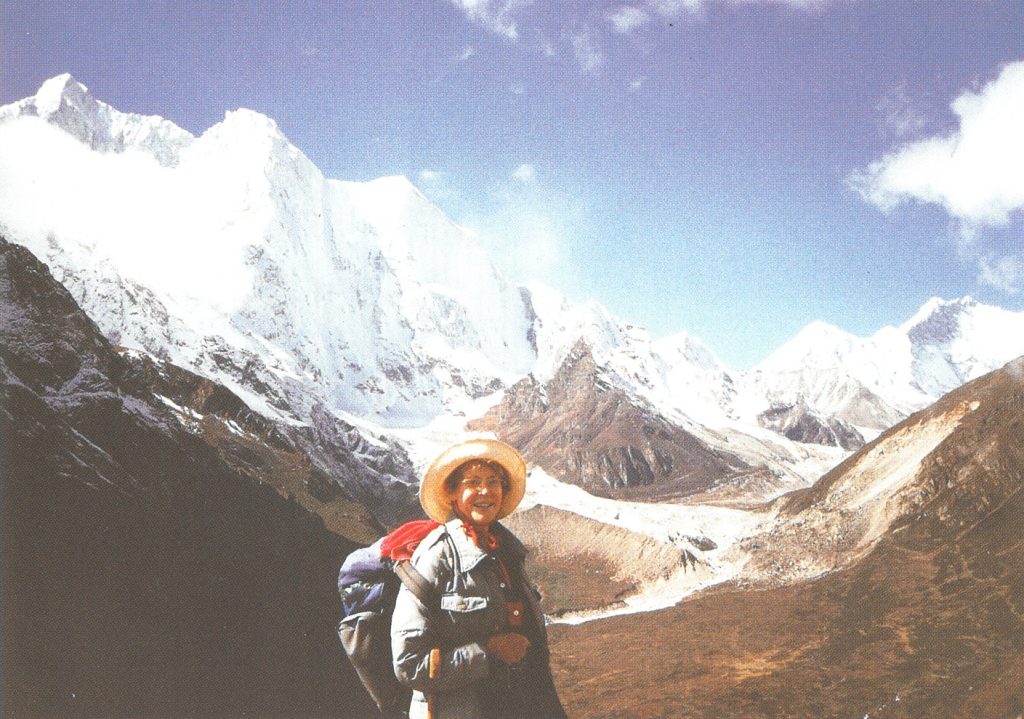
Kathleen Gemberling Adkison at Mount Everest Base Camp, 1993 (photo: Jean Kendall)

Born Kathleen Parks in Beatrice, Nebraska, in 1917, Katahleen would go on to become a well-known Pacific Northwest landscape painter. During the Great Depression, the Parks family moved to Seattle, Washington, where, in Kathleen’s final year of high school, she first received formal art instruction. But it wasn’t until she was mentored by renowned abstract expressionist, Mark Tobey, that she began to develop her distinct style. In a time when female artists were discouraged from painting anything other than portraits and genre paintings, Tobey’s instruction was highly subversive, as he never gave assignments and always encouraged his students to paint what they found interesting. “Before that class, I felt guilty for painting,” Gemberling-Adkison remembered, “I’d been punished in school for drawing, and made to feel that it was something I should try to ‘get over.’ He [Tobey] made me realize that painting was of some worth.”

In 1950, Kathleen moved to Spokane, Washington, where, removed from Tobey’s guidance, she spent time acquainting herself with the area’s natural landscape, later explaining that she enjoyed painting natural landscapes because she liked exploring the mysterious and unexamined places in nature and hoped for her paintings to be “something a person could meditate on” and for them to have elements “that couldn’t be seen at the first viewing.” It wasn’t ever just about the landscape, however. She viewed her landscape work as a metaphor for the layered complexities of human relationships more broadly, stating that “The closer you look, the richer people seem.”

Gemberling-Adkison was married three times. Not much is known about her early marriages aside from the understanding that, if given an ultimatum, Kathleen would invariably choose being a painter over being with a man. In an interview, she stated: “After my first marriage broke up, a psychiatrist told me if I’d just quit painting, my marriage would be OK. I never went back to him.”

Naturally, Kathleen wanted a spouse who would encourage her desire to create, not repress it, and, in 1968, she married Tom Adkison, a prominent Spokane-area architect. She and Tom would go on to travel the world together, visiting Europe and Asia, oftentimes hiking extensively and giving Kathleen inspiration for her paintings. Tom’s companionship indicates his support of Kathleen’s artistic endeavors, but it went further than travel and spending time in nature together, as he participated in shaping the work itself. In a 1978 interview, for instance, Kathleen gave Tom credit for naming all of her pieces. “I like titles, but I don’t name them and can’t think of any titles,” she said. “My husband thinks of all the titles.”
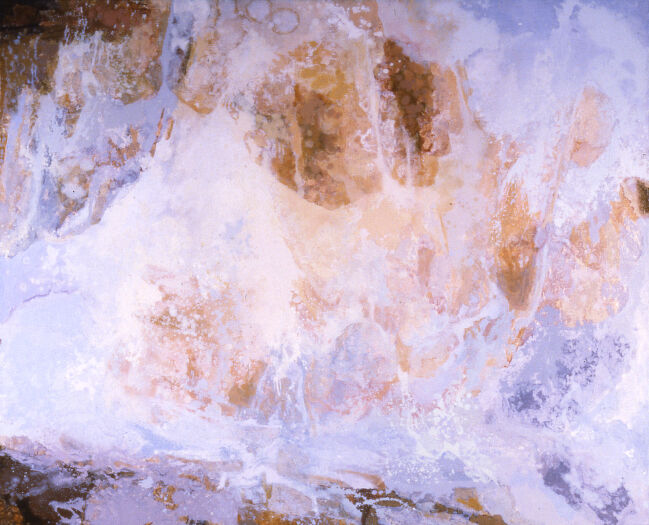
Everest

It is impossible to know what emotions Gemberling-Adkison was experiencing when Tom died in March of 1986, but, shortly after his death, she hiked to the base camp at Mount Everest with her friend Jean Kendall. After so many hikes in other countries with Tom, it’s difficult not to see this hike as a way of feeling connected to him after his death. Indeed, in April of 1986, Kathleen painted Everest. It’s difficult to conceptualize the vastness of the world’s tallest mountain, just as it’s impossible to fathom the death of a spouse, and Gemberling-Adkison captures this struggle in Everest. As with any colossal form encountered at close range, the painting has no distinct lines or shapes, emphasizing above all the inability to see, let alone understand, something so tremendous.
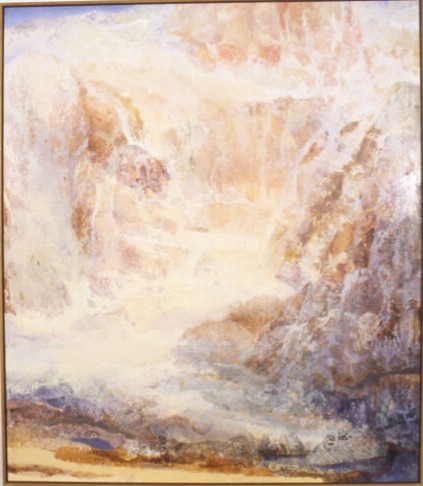
Base Camp

This inability to capture and decipher the whole picture can also be found in the undated work Base Camp. Depicting the conditions at Everest, the bright white colors work in tandem with warmer light pinks and yellows to create a very airy feeling, but it’s more than that. It’s an image that captures the camp’s beauty, but also a feeling of transcendence in the literal sense—not just of being at very high altitude, but of being enveloped in a cloud-like, heavenly state. This is a feeling, perhaps, that follows accomplishing a great feat in the face of hardship. Nor would Kathleen be willing to let that feeling go. Indeed, in 1993, at the age of 76, she completed the hike for the second time, again with her friend Kendall, proving once more that she was nothing if not stoutly determined to defy any and all conventions in her art, in her marriages, and in her grief.

Sources:

Didion, Joan. The Year of Magical Thinking. New York, Alfred A. Knopf, 2005. p.134 Newspaper clippings, 1980-1989, Series I, Box 1, Folder: 4. The Kathleen Gemberling Adkison

papers, WUA053. Willamette University Archives and Special collections.

Newspaper clippings, 1990-1999, Series I, Box 1, Folder: 5. The Kathleen Gemberling Adkison papers, WUA053. Willamette University Archives and Special collections.

Newspaper clippings, undated, Series I, Box 1, Folder: 6. The Kathleen Gemberling Adkison papers, WUA053. Willamette University Archives and Special collections.

Adkison interview, 1978 October 6, Series I, Box 1, Folder: 9. The Kathleen Gemberling Adkison papers, WUA053. Willamette University Archives and Special collections.

Adkison, Kathleen Gemberling. Adkison at Everest Base Camp. Photograph. Exhibitions, 1970
1999, Series I, Box 1, Folder 8. Kathleen Gemberling Adkison Papers (WUA053). Willamette University Archives and Special Collections.

Kathleen Gemberling Adkison Artworks, 1917-2010, OWS_WUA053_Adkison_art, https://digitalcollections.willamette.edu/collections/a4228fc3-ccaa-4132-b06f-28117b369 005
The Life and Death in Henk Pander’s Portraits

By Savanah Anderson, Class of 2028

“There is something fatal about a portrait. It has a life of its own,” writes Oscar Wilde in The Picture of Dorian Grey.1 Consider, for instance, the Mona Lisa. What can you tell me about that woman and her famous smile? Probably very little. In this way, it seems, the creation of a portrait is both a birth and a death; the original model replaced by a reproduction of themselves. This is the dilemma at the center of portraiture. How can an artist pick through the contents of a life like junk at a garage sale and decide how the subject will be remembered? This question is likely one intimately familiar to Henk Pander.

Pander, a Portland-based painter from the Netherlands, was primarily known for his Pacific Northwest landscapes and poster art, but it is his portraits I am concerned with.

Pander produced several portraits in his career, the most notable of which are Portrait of Delores and Prayer Before the Night. These paintings show in Pander’s body of work a unique fascination with death, so much so it might as well have been holding the brush. Both paintings are of figures nearing the ends of their lives, and it is through them and with the help of written archival information that we can begin to understand this strange pattern and how an artist like Henk Pander chooses to memorialize those closest to him.

Spurned by the negative reaction to his exhibition at Portland State University, Pander retreated from the art world to work at the Storefront Theater in Portland. There, he would work closely with director and costume designer Ric Young. In his own words, the two “began a long and creative friendship, which lasted until he died in the winter of 1992.”2 Perhaps, they felt a certain kinship, each being highly criticized artists and Ric being described as “vehemently opposed to any form of censorship.3 An ironically Wilde-esque figure, Young was an eccentric, ostentatious, and avant-garde artist. By all (admittedly limited) accounts, Ric was loved and admired within the theater community and, although often disliked by critics, he was certainly a topic of discussion for many of them. All things considered, he seems a man worth writing about, and maybe for a time he was, yet little information about him remains online.

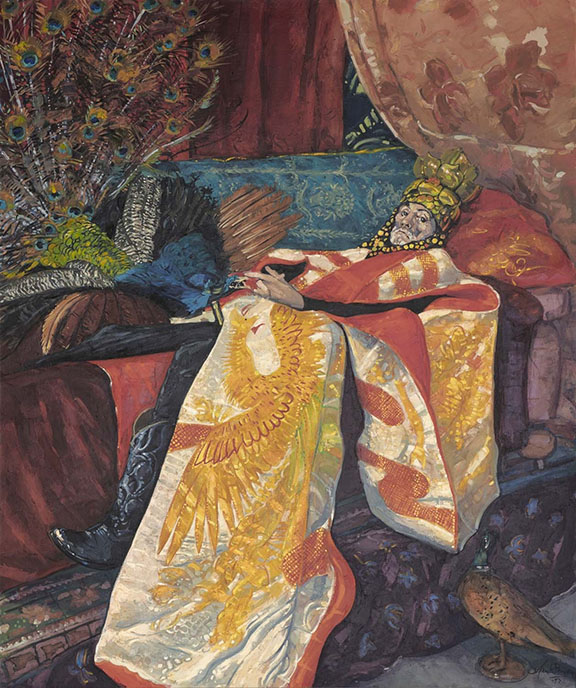
“Prayer Before the Night”, Henk Pander, 1992

What remains, however, is Prayer Before the Night. This painting, now kept in the Frye Art Museum in Seattle, shows Ric Young as he lay dying due to complications of AIDS. Although perhaps not the same lively man he used to be, this portrait is an homage to the life and legacy of a man not to be forgotten. He lay surrounded by colorful, ornate fabrics, his frail figure swallowed by a large, draped kimono. A peacock, commonly used as a symbol for beauty and extravagance, sits on the bed beside him. He wears edgy black cowboy boots and a large, gold crown. As Henk would write in a piece on Ric, “he became famous for his great head pieces”4 which he designed for the Storefront Theater.

This painting immortalizes a man, not who he was soon to become, but how he was and is remembered by those who knew and loved him. It tells us little about his illness, his family, or his body of work, and instead creates an image of beauty and extravagance—of a richness of life.

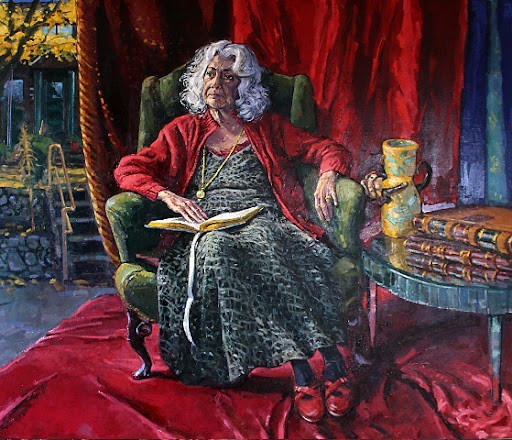
Portrait of Delores tells a very similar story. Pander married his second wife, Delores Rooney in 1978. Generally, following a line of curiosity and conventional essay structures, now would be when I tell you about Delores, and I wish that I could. Yet, little about Delores is known to the public. One obituary claims she took an “extraordinary supporting role”6 in her career. A biography, (on Henk, of course), says her “support…allowed him to focus on his paintings”7 Her life before her marriage to the artist is seemingly lost to time. She was a shadow in the legacy of her husband’s work. Or, that would be the case, if not for her portrait.

Portrait of Delores is a portrait of strength. Her posture is relaxed, yet her expression is stern and unrelenting. She holds a large book on her lap, an homage to her work in the literary field, and a colorful ceramic vase sits on the table beside her. She wears bright red Wizard-of-Oz-esque shoes, matching the elegant red of the drapes behind her. She is dignified and unafraid. Delores would be diagnosed with cancer in 2010, which would take her life shortly after. Henk kept a journal documenting the process of her treatments until she passed, now kept in the Hatfield Archives, which details the agonizing experience of the decline of her health. She became thin and haggard, dwarfed by her hospital bed, her bones showing through her skin like the wings of a bat. This painting does not show this time in her life, but who she was in spite of it. As Henk would say in his journal, “she has been strong, fearless, independent, dignified, and sad throughout the ordeal,” and although she was hard to recognize, “she is very much the same person”.8

“Portrait of Delores,” Henk Pander, 2009 9

A painting will never be able to hold a life within its frame. We will never know Ric or Delores as Henk did and their portraits cannot laugh and speak as they did. And yet their portraits outlive them, and the talent of Henk Pander cements the image of these figures, not as they died but as they lived, in our minds and history, impervious to the weather of time. Each of these paintings hold fragments of what can be found in archives, after hours of concentrated digging—a love of fashion or literature, a sense of strength, their family’s talents—condensed into a singular representation. And whether in a museum or a collection online, they exist for all to see and remember.


1 Oscar Wilde, The Picture of Dorian Gray (Sterling Publishing Company, Incorporated, 2020), p. 116.

2 “Ric Young, 1974, 1989–1992,” Series I, Box 5, Folder 12, Henk Pander Papers, WUA064, Willamette University Archives and Special Collections.

3 Ibid.

4 Ibid.

5 Henk Pander Catalogue of Artworks, 1991-2000, Willamette University Archives

6 Martha Ullman West, “Delores Pander, 1938–2010,” Art Scatter, June 25, 2010. Accessed October 22, 2025.

7 Roger Hull, “Henk Pander (1937–2023),” Oregon Encyclopedia, April 24, 2024. Accessed October 22, 2025.

8 The Delores Journal, January–June 2010, Series III, Box 12, Folder 11, Henk Pander Papers, WUA064, Willamette University Archives and Special Collections.

9 Henk Pander Catalogue of Artworks, 2001-2012, Willamette University Archives